
On December 15, 2025, the European Commission released the draft implementing act detailing the specific labeling requirements mandated by Regulation (EU) 2023/1542. The public comment period is currently open and will run through January 12, 2026 (Brussels time).
This implementing draft introduces more unified and detailed requirements for battery labeling, covering the following aspects:
Label Requirement 1
- Design, dimension and placement of labels;
- Labeling requirements for non-rechargeable batteries;
- Marking and labeling of restricted and hazardous substances;
- Priority order of different marking and labeling requirements;
- Language and accessibility;
- Carbon footprint labeling specifications.
Using portable rechargeable, SLl, and LMT batteries as examples, the design specifications are illustrated below. These clearly define mandatory data fields, element positioning, symbol dimensions.
typography (font size/style), and required clearance distances.
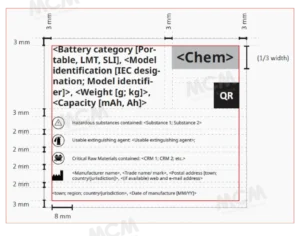
Label Requirement 2
Service
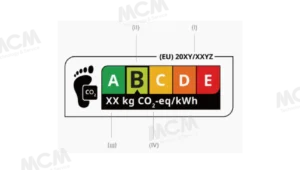
The regulation also specifies the format for carbon footprint labels:(1) Reference to delegateed act for carbon footprint performance classes; (ll)The battery’s performance class; (lll)& (lV) The numerical
value and its functional unit.
The act formalizes the naming conventions for electrochemical capositions. For rechargeable batteries, the designated markings are:
– Lead-acid battery: “Pb”
– Nickel-cadmium battery: “Ni-Cd”
– NMC lithium-ion battery: “Li-ion NMC”
– LFP lithium-ion battery: “Li-ion LFP”
– LMO lithium-ion battery: “Li-ion LMO”
– LCO lithium-ion battery: “Li-ion LCO”
– NCA lithium-ion battery: “Li-ion NCA”
– Lithium metal battery: “Li-metal”
– Sodium-ion battery: “Na-ion”
Tslhplementing act will take effect 20 days after its official publication and will become mandatory 18 months thereafter. All batteries placed on the market or put into service must satisfy these requirements,
non-compliant products will face restricted market access under Regulation(EU)2023/1542

MCM’s technical team possesses deep expertise in the Battery CE Marking landscape, providing clients with timely andpractical regulatory insights.We offer one-stop CE solutions, includingVD, EMC, and
Battery Directive testig,alongside specialized training, carbon footprint assessments, due. iligence, and end-to-end support for compliance documentation.
Ensure your products are ready for the EU market. Contact MCM today for a comprehensive compliance audit. Let’s unlock new possibilities MCM together!
About MCM
MCM is a leading global certification and testing solutions provider for battery products. It specializes in proactively offering certification and testing services across regions worldwide. As an independent third-party organization, MCM is established in compliance with ISO/IEC 17025 & 17020, the Review Criteria for Qualification Recognition of Inspection and Testing Institutions, the Administrative Measures for Qualification Recognition of Inspection and Testing Institutions, and relevant laws and regulations. It holds accreditations including CNAS, CMA, CBTL, and CTIA, and is certified under the ISO/IEC 27001 information security management system. As a third-party certification and testing institution focused on a single core mission, MCM collaborates globally with partners such as TUV RH, QUACERT, CQC, CCS, SIRIM, ICAT, CGC, the Second Research Institute of CAAC, and the National New Energy Testing Center. For products including traction batteries, energy storage batteries, and mobile communication/digital device batteries (as well as in the air transport sector), MCM has built a safe, efficient, and convenient integrated system for battery product certification and testing. This system enables over 5,000,000 models of batteries and their end products to circulate and sell smoothly across the globe.